
When an aircraft takes off, flies across controlled airspace, and lands safely at its destination, many aviation professionals contribute to that journey. Among the most important are Air Traffic Controllers (ATCs).
Working from control towers, approach control facilities, and area control centers, Air Traffic Controllers help manage aircraft movements and maintain safe separation between aircraft.
For people interested in aviation, ATC offers a career that combines communication, concentration, technology, decision-making, and responsibility.
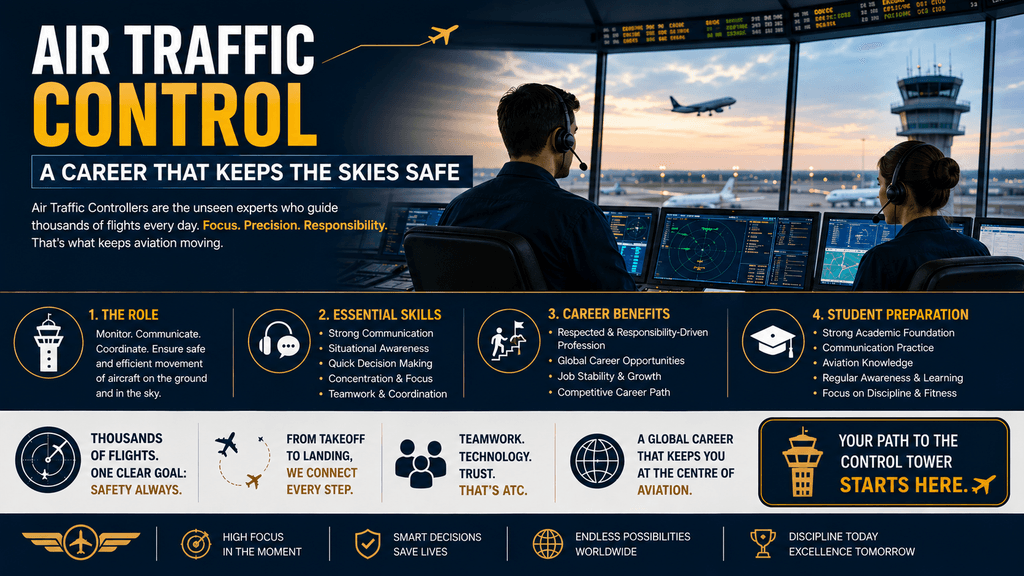
What Is Air Traffic Control?
Air Traffic Control is a critical part of aviation operations.
Air Traffic Controllers coordinate aircraft movements and provide instructions and information to pilots to support the safe and orderly flow of air traffic.
Their responsibilities vary depending on the type of airspace and control facility in which they work.
The three broad areas include:
- Aerodrome or Tower Control
- Approach Control
- Area or En-route Control
Each area requires professionals to understand aircraft movement, airspace procedures, communication protocols, and operational requirements.
What Does an Air Traffic Controller Do?
An ATC professional may be responsible for:
- Monitoring aircraft movements
- Communicating with pilots
- Providing clear instructions
- Maintaining appropriate aircraft separation
- Managing traffic flow
- Coordinating with other control units
- Monitoring changing operational conditions
- Supporting safe aircraft arrivals and departures
The work requires accuracy because aviation decisions can have a direct impact on flight safety.
Why Focus and Precision Matter
Air Traffic Control is an environment where professionals must remain focused while managing multiple pieces of information.
Controllers may need to monitor:
- Aircraft positions
- Flight routes
- Altitudes
- Weather conditions
- Runway activity
- Airspace restrictions
- Communication with flight crews
This makes concentration and situational awareness essential professional qualities.
Skills Required for an ATC Career
A successful Air Traffic Controller needs more than aviation knowledge.
Important skills include:
Communication
Instructions must be clear, concise, and unambiguous.
Concentration
Controllers need to maintain attention throughout demanding operational periods.
Decision-Making
ATCs regularly evaluate information and make timely operational decisions.
Situational Awareness
Understanding what is happening across the surrounding airspace is essential.
Teamwork
Air Traffic Control involves continuous coordination between controllers, pilots, airport teams, and other aviation professionals.
Stress Management
Controllers must remain calm and focused while handling complex situations.
Technology in Air Traffic Control
Modern ATC operations rely heavily on technology.
Controllers work with systems that help them monitor and manage aircraft movements, understand traffic situations, and coordinate operations.
Technology continues to evolve through areas such as surveillance systems, digital communication, navigation technologies, and air traffic management systems.
However, technology works alongside professional judgment and human decision-making.
A Career Built Around Responsibility
Air Traffic Control is not simply about communicating with pilots.
It is a profession built around:
Safety + Precision + Communication + Decision-Making + Teamwork
Every instruction and coordination activity contributes to maintaining an organized and safe air traffic environment.
The Importance of ATC in Modern Aviation
As global air traffic grows, efficient air traffic management becomes increasingly important.
Air Traffic Controllers help maintain an orderly flow of aircraft while supporting safe operations across airports and controlled airspace.
Their contribution may not always be visible to passengers, but it is fundamental to modern aviation.
Final Thoughts
Air Traffic Control is one of aviation’s most demanding and respected professional fields.
For individuals who enjoy aviation, technology, communication, teamwork, and making decisions under pressure, understanding the ATC career path can open the door to an important area of the aviation industry.
Behind every aircraft moving safely through controlled airspace is a team of professionals watching, communicating, coordinating, and making informed decisions.