
Airports are busy environments where thousands of passengers move through check-in areas, security checkpoints, boarding gates, baggage claim zones, and arrival halls every day. For many travellers, especially first-time flyers and international passengers, navigating a large airport can be challenging.
This is where Airport Information Desks play an essential role.
Information desk professionals are often among the first people passengers approach when they need assistance. Their ability to provide clear, accurate, and timely information can directly influence the overall passenger experience.
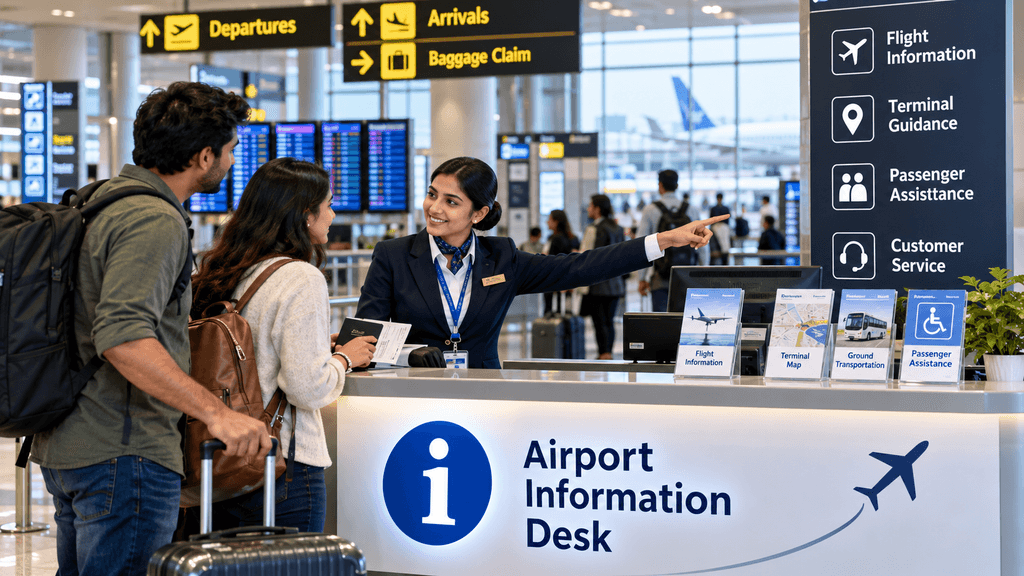
What Is an Airport Information Desk?
An airport information desk is a dedicated passenger-support point located within an airport terminal. It helps travellers find the information they need to continue their journey smoothly.
Depending on the airport, information desk staff may assist passengers with flight information, terminal navigation, airport facilities, transportation options, accessibility services, and other general enquiries.
1. Passenger Assistance
Passenger assistance is one of the busiest responsibilities at an airport information desk.
Travellers may approach the desk with questions about check-in counters, boarding gates, baggage claim, security checkpoints, immigration areas, airline counters, airport facilities, or ground transportation.
The staff must listen carefully, understand the passenger’s requirement, and provide clear directions or refer the passenger to the appropriate airline, airport department, or authority.
2. Flight Information
Passengers frequently need help understanding flight-related information.
Information desk staff may guide passengers in locating the correct departure or arrival information, terminal, airline counter, or boarding area. However, operational information can change quickly, so passengers should always verify critical flight details using official airport or airline information displays and announcements.
3. Terminal Guidance
Modern international airports can contain multiple terminals, levels, concourses, gates, lounges, restaurants, retail outlets, transportation areas, and service facilities.
Information desk professionals help passengers understand the terminal layout and identify the correct route to their destination.
Good terminal guidance reduces confusion and helps passengers move through the airport more efficiently.
4. Customer Service
Technical knowledge alone is not enough for this role. Customer service skills are equally important.
Airport information professionals interact with people from different countries, cultures, age groups, and language backgrounds. Some passengers may be stressed because of delays, missed connections, lost baggage, unfamiliar procedures, or time pressure.
Staff therefore need strong communication skills, patience, professionalism, problem-solving ability, and a passenger-focused attitude.
Why Are Airport Information Desks Important?
An airport journey involves several interconnected processes. Even when airport systems and signage are well designed, passengers sometimes need human assistance.
An effective information desk can help reduce uncertainty, direct passengers to the right service point, and create a more welcoming airport environment.
For this reason, information desk professionals form an important part of the wider airport operations and passenger-service ecosystem.
Skills Required for Airport Information Desk Roles
Professionals interested in passenger-facing airport careers can benefit from developing:
- Clear verbal communication and active listening
- Customer-service and interpersonal skills
- Knowledge of airport terminology and terminal operations
- Basic understanding of airline and passenger procedures
- Problem-solving and decision-making ability
- Professional appearance and workplace etiquette
- Ability to remain calm in busy situations
- Confidence when communicating with passengers from diverse backgrounds
Career Opportunities
Experience in passenger assistance and airport customer service can be relevant to a variety of aviation and airport-service roles, depending on an employer’s qualifications and recruitment requirements.
These may include passenger service, customer support, terminal assistance, guest relations, airline ground services, airport operations support, and related functions.
For students interested in aviation careers beyond the cockpit, understanding passenger handling and terminal operations provides useful exposure to how airports function every day.
Conclusion
Great airport experiences begin with accurate information.
Airport Information Desks connect passengers with the information, directions, and assistance they need throughout their journey. Behind every helpful answer is a professional who understands both airport operations and the importance of customer service.
At X Aviate International Aerospace, aviation education can go beyond aircraft and flying by helping learners understand the wider ecosystem of airports, airlines, operations, and passenger services.
Learn Aviation. Understand the Industry. Build Your Future.