
What is Aeronautical Knowledge?
Every successful pilot begins their journey long before entering the cockpit. While practical flying skills are essential, safe and professional aviation depends equally on a strong theoretical foundation known as aeronautical knowledge.
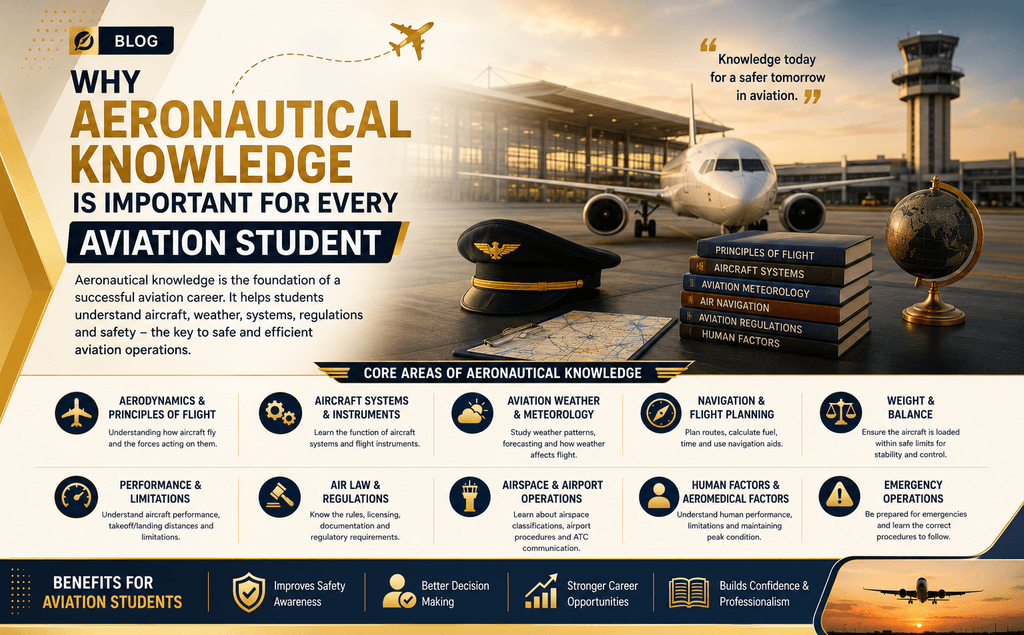
Aeronautical knowledge is the study of aviation principles, aircraft operations, aviation regulations, weather, navigation, aircraft performance, and human factors. It provides pilots with the understanding needed to make informed decisions before, during, and after every flight.
Whether you dream of becoming a commercial pilot, airline captain, aviation manager, or flight operations specialist, mastering aeronautical knowledge is the first step toward building a successful aviation career.
Why is Aeronautical Knowledge Important?
Flying is more than controlling an aircraft.
Every flight requires continuous decision-making based on technical knowledge, weather analysis, aircraft performance, and aviation regulations.
Strong aeronautical knowledge helps pilots:
- Improve flight safety
- Make better operational decisions
- Understand aircraft systems
- Respond effectively during emergencies
- Communicate efficiently with Air Traffic Control (ATC)
- Meet aviation regulatory requirements
- Build confidence during pilot training
Professional pilots rely on knowledge just as much as flying skills.
The 10 Core Areas of Aeronautical Knowledge
1. Aerodynamics and Principles of Flight
Understanding how an aircraft flies begins with learning the four fundamental forces:
- Lift
- Weight
- Thrust
- Drag
Pilots also study:
- Stall characteristics
- Spins
- Aircraft stability
- Load factors
- Control surfaces
These principles explain how aircraft behave during different phases of flight.
2. Aircraft Systems and Flight Instruments
Pilots must understand how aircraft systems operate before they can safely manage them.
Important systems include:
- Engine systems
- Fuel systems
- Electrical systems
- Hydraulic systems
- Landing gear
- Flight controls
Students also learn to interpret cockpit instruments such as:
- Airspeed Indicator
- Altimeter
- Vertical Speed Indicator
- Artificial Horizon
- Heading Indicator
Understanding these systems improves operational safety and troubleshooting skills.
3. Aviation Weather and Meteorology
Weather is one of aviation’s most important safety factors.
Pilots learn how to evaluate:
- Atmospheric pressure
- Temperature
- Wind
- Clouds
- Visibility
- Thunderstorms
- Turbulence
- Wind shear
- Icing
They also learn how to interpret aviation weather products including:
- METAR
- TAF
- SIGMET
- AIRMET
- Weather charts
Good weather knowledge reduces operational risk significantly.
4. Navigation and Flight Planning
Every flight begins with careful planning.
Pilots study:
- Pilotage
- Dead reckoning
- Radio navigation
- GPS navigation
- Flight planning
- Fuel calculations
- Wind correction
- Time estimation
Proper navigation ensures flights remain efficient, safe, and compliant with aviation procedures.
5. Weight and Balance
Aircraft performance depends heavily on proper loading.
Pilots calculate:
- Total aircraft weight
- Center of Gravity (CG)
- Passenger loading
- Baggage distribution
- Fuel weight
Incorrect weight distribution can affect aircraft stability and controllability.
6. Aircraft Performance
Aircraft performance changes based on operating conditions.
Students learn how factors such as:
- Temperature
- Altitude
- Runway length
- Aircraft weight
- Wind
affect:
- Takeoff distance
- Landing distance
- Climb performance
- Fuel efficiency
Understanding performance limitations helps pilots operate safely in varying environments.
7. Aviation Regulations and Air Law
Professional pilots must understand aviation laws before operating any aircraft.
Important topics include:
- Rules of the Air
- Pilot licensing
- Medical certification
- Aircraft documentation
- Operational limitations
- Flight responsibilities
Following aviation regulations ensures legal compliance and enhances safety.
8. Airspace and Airport Operations
Different airspace classifications have different operational requirements.
Pilots study:
- Controlled airspace
- Uncontrolled airspace
- Airport markings
- Taxiway signs
- Runway lighting
- Aeronautical charts
- Standard radio phraseology
Effective communication with Air Traffic Control is an essential part of professional flying.
9. Human Factors and Aeromedical Knowledge
Human performance directly affects aviation safety.
Students learn about:
- Fatigue
- Stress
- Hypoxia
- Spatial disorientation
- Vision limitations
- Decision-making
- Situational awareness
- Crew Resource Management (CRM)
Many aviation incidents involve human factors rather than aircraft failures.
10. Emergency Procedures
Pilots prepare extensively for unexpected situations.
Training includes:
- Engine failures
- Electrical failures
- Fire emergencies
- Forced landings
- Emergency checklists
- Distress communications
Emergency preparedness increases pilot confidence and enhances passenger safety.
How Aeronautical Knowledge Supports Pilot Training
Flight training combines classroom learning with practical flying experience.
Students first understand the theory before applying it during flight lessons.
This integrated learning approach helps pilots:
- Make informed decisions
- Improve situational awareness
- Understand aircraft limitations
- Develop safer flying habits
Strong theoretical knowledge builds a solid foundation for advanced aviation training.
Career Opportunities That Require Strong Aeronautical Knowledge
Aeronautical knowledge is valuable across many aviation careers, including:
- Commercial Pilot
- Airline Pilot
- Flight Dispatcher
- Airport Operations Executive
- Aviation Safety Officer
- Flight Operations Officer
- Air Traffic Services Support
- Aviation Management Professional
- Ground Operations Executive
- Aviation Instructor
As aviation technology continues to evolve, employers increasingly value professionals with strong technical knowledge and decision-making skills.
Final Thoughts
Aeronautical knowledge is the backbone of safe and professional aviation. It equips aspiring pilots with the technical understanding, operational awareness, and decision-making skills required throughout their careers.
Whether your goal is to become a commercial pilot or pursue another aviation profession, investing time in building strong aeronautical knowledge is one of the best decisions you can make.
At X Aviate International Aerospace, students are encouraged to strengthen both theoretical understanding and practical skills, preparing them for the dynamic and safety-focused world of aviation.